
What Does an Assistant Property Manager Do? (US & Canada)
What assistant property managers do, US and Canadian licensing, real 2026 pay from live job ads and how to land your first role on the way to property manager.
Behind every well-run apartment community or office building there's a property manager. And right beside them, keeping the whole operation moving, is the assistant property manager.
It's one of the best entry points into a property career in the USA and Canada. You learn the business side of real estate from the inside, get paid while you learn, and the next step up is clear. Here's what the job really involves, what it pays right now and how to land your first role.
What does an assistant property manager do?
An assistant property manager (APM) supports the property manager in running one building or a portfolio. In practice you're the person who makes sure rent comes in, residents or tenants are looked after, repairs get done and the numbers stay on track.
A typical week might include:
- Rent and receivables. Posting payments, chasing late balances and setting up payment plans.
- Leasing and renewals. Helping the leasing team, approving applications against screening criteria, and preparing renewal offers. (If you're starting even earlier, our leasing agent guide covers that role.)
- Resident and tenant relations. Handling complaints, notices and move-ins and move-outs, and calming things down when emotions run high.
- Maintenance coordination. Logging work orders, scheduling vendors and following up with the maintenance team so jobs actually get closed.
- Paperwork and compliance. Keeping lease files, insurance certificates and inspection records tidy.
- Budgets and reporting. Coding invoices, tracking spending against budget and helping prepare monthly owner reports with the property accountant.
- Running the show. When the property manager is away, you're in charge.
Residential vs commercial. Most APM jobs are in multifamily housing, where the work is fast-paced and people-heavy. Commercial APMs deal with fewer, bigger tenants, so the work leans more on leases, vendor contracts, expense recoveries and building engineers.
The skills that matter
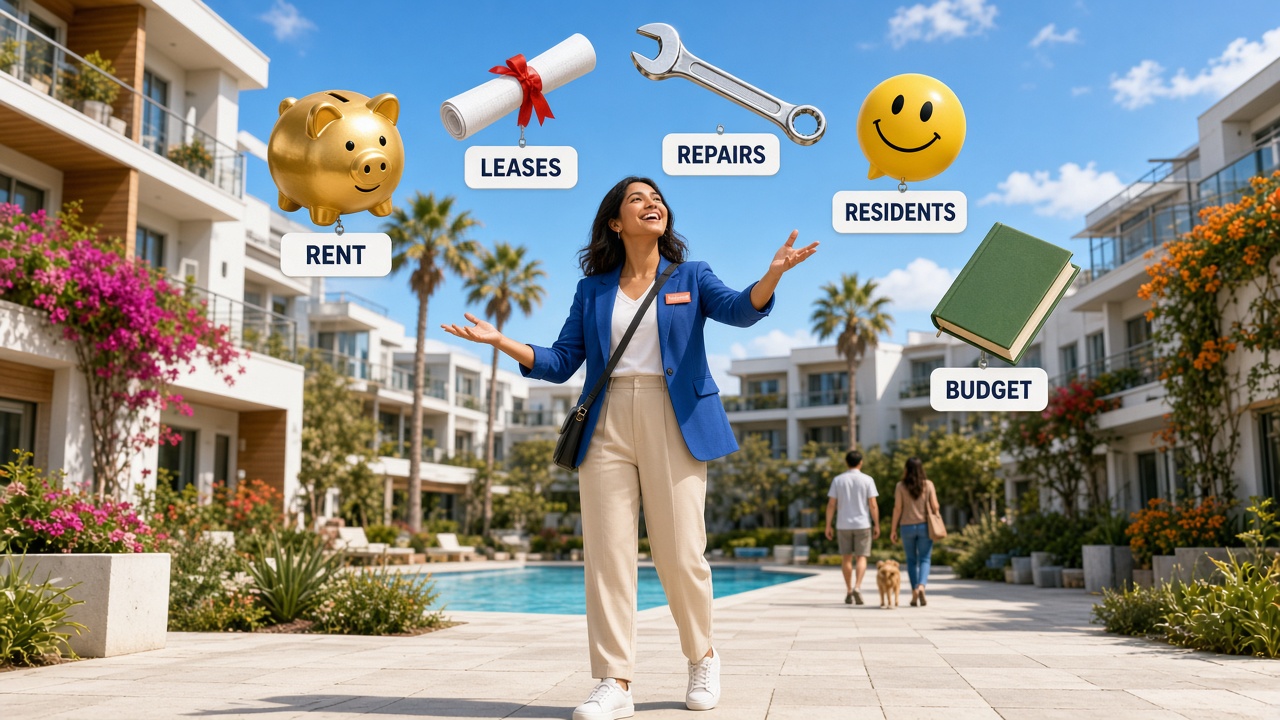
Organization. You'll juggle rent, repairs, residents and reports at once. People who keep good lists do well.
Calm, friendly communication. You'll hear from residents on their worst days. Staying warm and firm at the same time is a superpower in this job.
Basic numbers. You should be comfortable with spreadsheets, budgets and a rent roll.
Tech fluency. Property management runs on software such as Yardi, RealPage, AppFolio, Entrata and MRI. AI assistants such as Grok Bot, ChatGPT or Claude are handy for drafting resident notices, summarizing leases and tidying reports. Just check the facts and legal wording before anything goes out.
Licensing and credentials in the US
Rules vary a lot by state. The Bureau of Labor Statistics notes that in most states property managers need a property management license or a real estate broker's license, and some states also license community association managers. Assistants often work under a licensed manager or broker, but don't assume. Check your state's real estate commission, or use the CareerOneStop license finder.
Credentials aren't usually required to get hired, but they help you move up. The National Apartment Association's Certified Apartment Manager (CAM) needs at least 12 months of on-site property management experience, which makes it a natural goal for a first- or second-year APM. NAA also offers CALP for leasing professionals and CAPS for portfolio supervisors. On the commercial side, groups like BOMI and IREM offer well-respected designations.
Licensing in Canada
Property management is regulated by each province:
- Ontario: Anyone providing condo management services needs a licence from the CMRAO. Newer managers with under two years' experience hold a Limited Licence and work under the supervision of a General Licensee.
- British Columbia: Rental property management is licensed by BCFSA. You complete the UBC Sauder Rental Property Management Licensing course, score at least 70% on the exam, pass a criminal record check and have your application approved by a managing broker.
- Other provinces have their own regulators and rules, so check locally before you apply.
What it pays
Pay depends heavily on city, property type and whether the role is residential or commercial.
- US average: ZipRecruiter puts the national average at $45,338 a year, about $21.80 an hour (as of Nov. 20, 2026). Most fall between $37,000 and $50,500, and the top 10% earn about $63,500.
- Live US job ads: In a scan of Indeed postings from Nov. 9 to 19, 2026, multifamily APM roles in Little Rock, Lafayette and Houston paid $21 to $22 an hour, a Chicago multifamily role offered $55,000 to $60,000, and commercial roles paid much more: $33 to $38 an hour at Cushman & Wakefield in Chicago, $80,000 to $89,250 at Lincoln Property Company in Washington, DC, and $87,245 to $118,155 at BXP in New York.
- Canada: Live Indeed postings from early to mid November 2026 ranged from C$40,000 to C$49,000 in Milton, Ontario, and C$50,000 to C$60,000 in Edmonton, up to C$60,000 to C$70,000 in Toronto and C$70,000 to C$85,000 in Vancouver. Job Bank's assistant property manager wage page shows a much higher median of $48.08 an hour (2024 to 2025). It draws on the wider occupation group, so treat it as a sign of where the career can take you.
The big upside is the next step. BLS puts the median for property, real estate and community association managers at $69,990 (May 2025), with the top 10% earning over $139,680 and about 36,900 openings a year projected over the decade.
Career path
A common route looks like this:
- Leasing consultant or administrative assistant on site
- Assistant property manager
- Property manager, running a building or community
- Senior or regional property manager, overseeing several properties
- Director of property management, or a move into asset management
BLS confirms many people start as assistant managers and move up over time. Some APMs branch into community association management, property accounting or leasing leadership instead.
How to get started
- Get in the door on site. A leasing, front desk or admin job at a large management company is the fastest route, and big operators promote from within.
- Show you can handle money and people. Retail, hospitality and customer service experience translates brilliantly.
- Check your licensing early. If your state or province requires a license, start the coursework while you job hunt.
- Plan your CAM. Once you've got a year on site, a credential like CAM shows you're serious about moving up.
If you like variety, enjoy helping people and want a real career path, this is a fantastic place to start.
Ready to take the first step? Browse assistant property manager and property management jobs across the USA and Canada.