
What Does an Apartment Maintenance Technician Do? (US & Canada)
What apartment maintenance techs do, the skills you need, EPA 608, CAMT and Canadian refrigerant rules, real BLS and Job Bank pay data, and how to start.
When a resident's air conditioning dies on a 100-degree July afternoon, they don't call the property manager to fix it. They call the maintenance technician. A tech who shows up fast and fixes it does more for resident retention than any marketing campaign.
Apartment maintenance technicians are the people who keep rental housing running. It's one of the most practical, in-demand and underrated jobs in property, and you can start without a degree. Here's what the work involves, the certifications that matter, what it pays and where it leads.
What a maintenance tech actually does
A maintenance technician (often called a "maintenance tech," and in Canada frequently a "building superintendent" or "super") looks after the buildings, units and common areas of an apartment community. A typical week mixes:
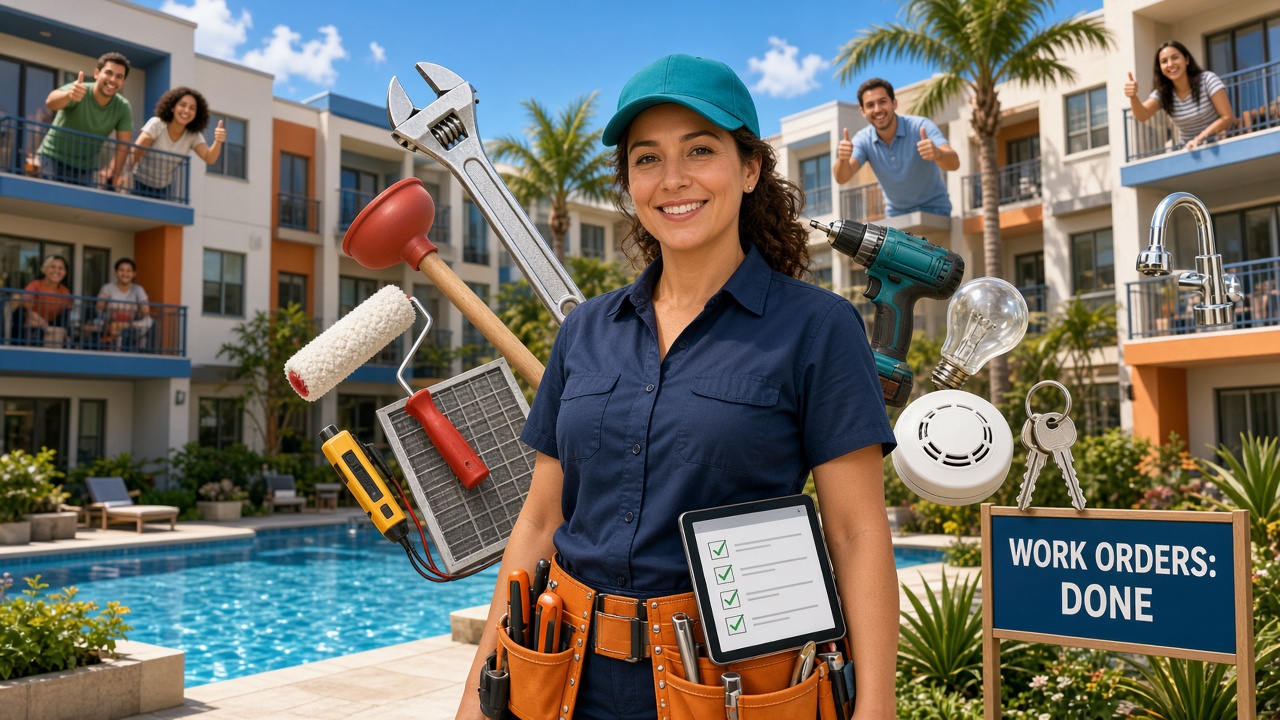
- Work orders. Leaky faucets, clogged drains, broken garbage disposals, tripped breakers, sticky doors, dead smoke detector batteries. These are logged by residents, usually through an app, and the tech works through them by priority.
- Make-readies (unit turns). When a resident moves out, the unit needs to be inspected, repaired, painted, cleaned and ready for the next person, often within days. Fast, quality turns keep occupancy high.
- HVAC, plumbing, electrical and appliances. Diagnosing and fixing the systems that make a home livable, within the limits of your training and local licensing rules.
- Preventive maintenance. Changing filters, checking water heaters, inspecting roofs and pools, servicing equipment before it fails.
- Emergency on-call. Most communities rotate on-call duty for nights and weekends. Floods and no-heat calls don't wait for Monday.
- Vendor coordination. For jobs above your pay grade, like major electrical or roofing work, you'll meet and supervise licensed contractors.
The Bureau of Labor Statistics notes that general maintenance and repair workers handle tasks "not complex enough to need the specialized training of a licensed tradesperson," and coordinate with electricians, plumbers and HVAC mechanics when a job goes beyond that. About 20% of these workers are employed in real estate and rental and leasing, the single biggest property slice of the occupation.
The skills that matter
Broad hands-on ability. You don't need to be a master of any one trade. You need to be good at a lot of them: a bit of plumber, electrician, carpenter, painter and appliance repairer.
Troubleshooting. The best techs think like detectives: why is this water heater failing when the one next door is fine?
Customer service. You're working in people's homes. Being polite, tidy, on time and clear about what you've done matters as much as the repair.
Time management. Juggling a dozen open work orders, an urgent leak and two make-readies needs real organization.
Tech comfort. Work orders, photos and parts orders now run through property management apps on your phone. AI tools such as Grok Bot, ChatGPT or Claude can help look up error codes or summarize equipment manuals. Handy, but always verify before you touch anything live.
Certifications and licensing in the US
Most states don't license general maintenance technicians, but some tasks need specific credentials. BLS points out that more complex electrical or plumbing work may require a license, and requirements vary by state and locality.
The two credentials that come up on almost every apartment maintenance job ad:
- EPA Section 608 certification. Under federal rules, anyone who maintains, services or repairs equipment that could release refrigerants, such as air conditioners and refrigerators, must be certified. The EPA offers Type I (small appliances), Type II (high-pressure equipment, which covers most residential AC), Type III (low-pressure) and Universal. Many techs simply get Universal.
- CAMT (Certificate for Apartment Maintenance Technicians). Run by the National Apartment Association Education Institute, the CAMT covers electrical, HVAC, plumbing, appliances, interior and exterior repairs, fair housing compliance and customer service. Candidates need 12 months of apartment maintenance experience, though newer techs can earn a Provisional CAMT and upgrade within two years. Better still, 85% of respondents to NAAEI's 2025 survey said their employer covered the full cost.
Certifications and licensing in Canada
Canada also leaves general building maintenance largely unlicensed, but refrigerants and regulated trades are a different story. In Ontario, you need an Ozone Depletion Prevention (ODP) card to handle refrigerants, earned through a short approved course such as HRAI's. Note that the ODP card doesn't authorize you to repair refrigeration equipment; that needs the appropriate trade qualification. Other provinces have their own refrigerant and trade rules, and licensed trades like electrical and gas fitting are regulated provincially, so check with your provincial apprenticeship or skilled trades authority.
What it pays
The BLS puts the median annual wage for general maintenance and repair workers at $49,590 (May 2025), or $23.84 an hour. The lowest 10% earned under $35,350, and the top 10% more than $77,180. In real estate and rental and leasing specifically, the median was $48,360.
The outlook is steady: employment is projected to grow 4% from 2025 to 2035, with around 148,700 openings a year, mostly as people retire or move on.
In Canada, Job Bank lists a national median of $25.00 an hour for general building maintenance workers and building superintendents, with a range of $16.55 to $38.46.
My view: the base pay is solid, and the real upside comes from stacking credentials and moving up. Ask about on-call pay and bonuses when you interview.
Career path
- Maintenance assistant, porter or make-ready tech. Learn the basics, painting, cleaning and simple repairs.
- Maintenance technician. Run your own work orders and take on-call shifts.
- Lead tech or maintenance supervisor. Own the community's maintenance, train others, manage vendors and budgets.
- Regional maintenance manager, building engineer or facilities manager. Oversee multiple properties or bigger, more complex buildings.
Some techs complete a full apprenticeship in HVAC, electrical or plumbing and become licensed tradespeople. Others move into property management. Either way, the skills travel.
How to get started
- Apply for porter or make-ready roles at large apartment operators. Many will train you.
- Get your EPA 608 (or ODP card in Ontario) early. It's quick and immediately makes you more hireable.
- Enroll in CAMT once you're in, ideally on your employer's dime.
- Build a starter tool kit and learn to document every job with photos and notes.
- Look into local trade school or pre-apprenticeship programs if you want to go deeper into HVAC or electrical.
It's a job where you see the results of your work every day, and residents genuinely appreciate it.
Ready to get hands-on? Browse apartment maintenance and property jobs on PropertyRoles and find your next role.