
Construction Jobs Grew in 37 States. Here's Where to Look
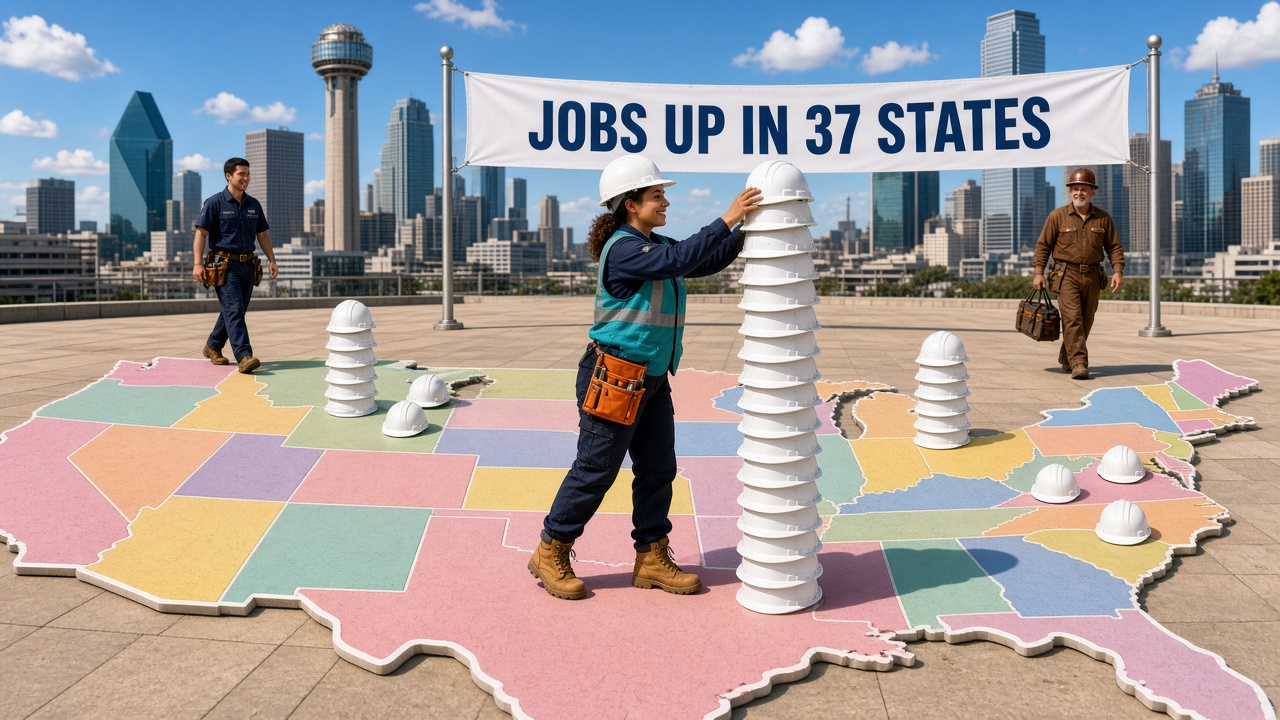
Construction jobs grew in 37 states and D.C. in the year to October. Texas, Ohio and Louisiana lead. Here's where the work is and what it means for you.
If you work in construction, or you're thinking about getting into it, here's a number worth knowing: 37 states plus Washington, D.C. had more construction jobs in October 2026 than a year earlier. That's from the Associated General Contractors of America (AGC), which crunched the latest federal state employment data and released it on Friday, November 20.
National headlines about construction have been gloomy lately, with builder confidence down and costs climbing. But a national average hides a lot. Look state by state and you see a different picture: some places are crying out for workers, and a few are cooling. If you're open to moving, or just want to know where the pressure is, this is the map to study.
Where construction jobs grew the most
Between October 2025 and October 2026, AGC says these states added the most construction jobs:
- Texas: +26,900 jobs (+3.0%)
- Ohio: +18,000 (+7.0%)
- Louisiana: +17,600 (+13.0%)
- Illinois: +16,100 (+6.7%)
- North Carolina: +12,200 (+4.3%)
By percentage, Louisiana led the country at 13.0%, followed by Iowa (+8.4%, 7,000 jobs), New Mexico (+7.4%, 4,000 jobs), Ohio and Illinois.
Louisiana's jump is the one that made me sit up. A 13% rise in a year is a boom by any measure. When a state's construction workforce grows that fast, contractors usually can't find enough experienced people, and that's when wages, overtime and fast-track promotions show up.
Where jobs went backward
It isn't up everywhere. Thirteen states shed construction jobs over the year. The biggest losses were in:
- Georgia: -6,300 (-2.7%)
- New Jersey: -5,300 (-3.2%)
- New York: -4,500 (-1.2%)
- West Virginia: -1,600 (-4.5%)
- Montana: -1,200 (-3.2%)
West Virginia had the steepest percentage drop, followed by Alaska (-3.2%), Montana, New Jersey and Georgia.
The month-to-month picture is more mixed. From September to October, 29 states added jobs, 15 lost jobs, and six states and D.C. were flat. Texas added another 6,900 jobs in the month alone. New York lost 6,100 and California 4,800.
The permitting fight that could unlock more hiring
AGC used the release to push Congress on permitting reform, and the timing matters. On Thursday, November 19, the Senate passed the Bipartisan American Affordability and Jobs Act of 2026 by 62 votes to 33, according to CNBC. The bill aims to speed up environmental reviews, mainly for energy and transmission projects. The Hill reports it would also require lawsuits against projects to be filed within 150 days of approval. It now goes to the House.
AGC chief economist Ken Simonson put the jobs link plainly: "When projects stall, construction firms may delay hiring, reduce hours or lay off workers, creating uncertainty for skilled tradespeople and weakening local economies."
Permitting reform is controversial, and the House may still change the bill or stall it. My take: whatever happens in Washington, the projects already in the ground in Texas, Ohio and Louisiana need people now. If the bill becomes law, it adds to the pipeline. It doesn't create the demand from scratch.
What this means for your career
If you're in a hot state, ask for more. In fast-growing markets, experienced superintendents, project managers, estimators and safety pros have real negotiating power. Our guides to the construction superintendent, construction project manager and cost estimator roles show what each pays and how to move up.
If you're in a cooling state, don't panic. A 1% to 3% dip is a slowdown, not a collapse. It's a good time to add a skill that travels: a safety certification (see our construction safety manager guide), scheduling software or estimating. Those skills make you employable anywhere.
If you're thinking about relocating, look past the headline state to the metro. Big gains often cluster around a few huge projects such as data centers, power plants and factories. We covered that trend in where data centers are sending construction jobs.
If you're new to construction, this is still one of the best doors in property. The industry faces a retirement wave (we covered the 3 million workers who could leave by 2031), and the states adding jobs fastest are where apprentices and entry-level project coordinators get trained quickest.
Use tech to job-hunt smarter. AI assistants such as Grok Bot, ChatGPT or Claude can help you compare cost of living between, say, Columbus and Dallas, or tailor your résumé to a superintendent job in Baton Rouge. Treat them as a starting point and check the numbers yourself.
For Canadian readers
This data covers US states only. Canada has its own construction squeeze and federal push to build. Our recent look at Canada's 2026 budget and the construction labor shortage covers what that means for jobs north of the border.
The bottom line
The national construction story is a little bumpy right now. The state story is much more interesting. Texas, Ohio, Louisiana, Illinois and North Carolina are hiring hard, and if Congress clears the permitting bill, more projects could break ground sooner. If you've got skills and you're willing to follow the work, the map is on your side.
Ready to find your next role? Browse construction and property jobs across the USA and Canada.